Assembling a Mongolian ger is not only a fascinating process, but also a way to immerse yourself in ancient nomadic culture.
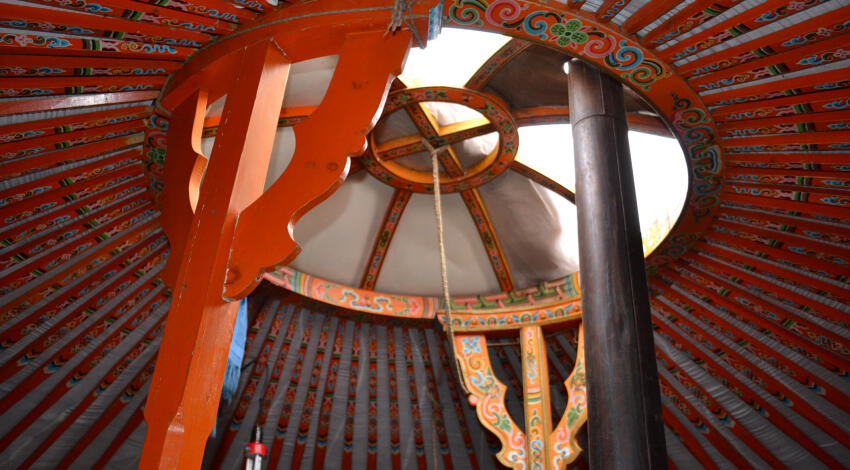
The toono (crown window) lets in natural light and fresh air. It can be opened on warm days or covered during rain and cold temperatures.
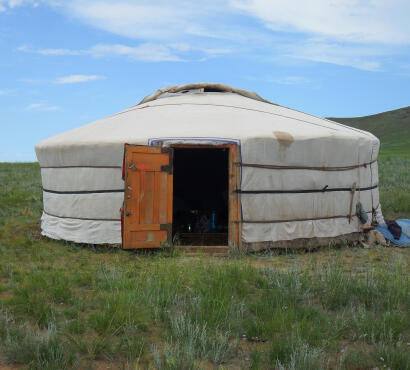
For thousands of years, nomadic herders of Mongolia roamed across the countryside from season to season. In the country where pasture was and still is a public domain, the herders moved freely to the best locations for the season. With this lifestyle of freedom of movement and pastoral animal husbandry was invented the national dwelling called the “Mongol Ger”. It is a round structure of easily dismantled walls, poles and a round ceiling covered with canvas and felt, tightened with ropes. The Ger was designed to be light enough for Mongolian nomads to carry, flexible enough to fold up, pack, and assemble, sturdy enough for multiple dismantling and assembling as well as easy for regulating temperatures within.
Over many centuries the Mongol Ger was modified into a perfectly aerodynamic structure, which can withstand Mongolia's fierce spring winds ranging up to 18-20 m/sec. It can be dismantled in half an hour and assembled in an hour by a small family with 2-3 adults. The Mongol Ger has many varieties. The most common “5-wall Ger” consists of five lattice segments forming a circular wall, a door, a Toono (round window ceiling), two Bagana (columns that hold the toono), and 88 Uni (long poles that connect wall lattices and Toono which forms the roof of the Ger), where on this frame are placed three to four layers of felt, traditionally made from sheep’s wool, and an outer layer of waterproof canvas.
Traditional gers feature wooden structures painted with Mongolian ornamentation, covers of white felt and canvas, ropes of animal hair, and hand-sewn felt flooring and carpets.
Steps for Assembling a Mongolian Traditional Ger
It can be dismantled in half an hour and assembled in an hour by a small family with 2-3 adults. The process follows the same order that Mongolian nomads have used for centuries - from raising the lattice walls to laying the final canvas cover.
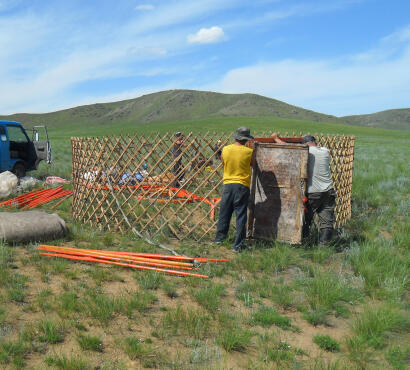
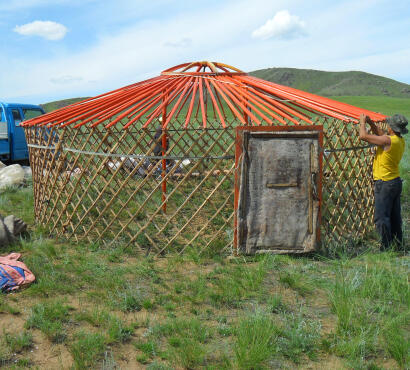
1. Placing the wooden lattice walls (khana) in circle and connecting them to the door frame. Traditionally, the door should face the south.
2. Roof assembly of ger: install the two support Pillars (bagana) and Crown (Toono), then connecting them to the wooden lattice walls.
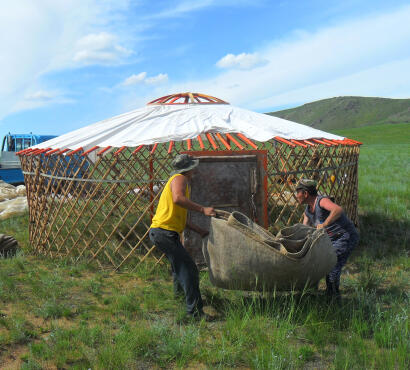
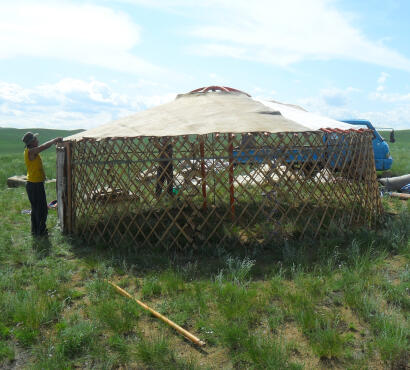
3. Laying the first linen cover over the roof frame while preparing the felt insulation layers.
4. Draping the felt insulation layer over the linen roof cover.
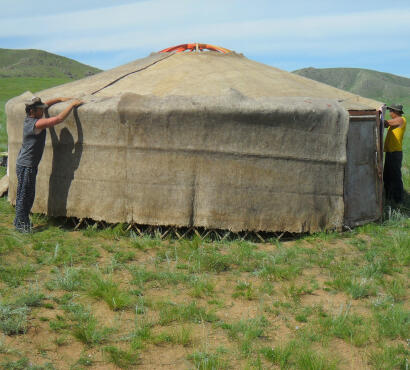
5. Covering the walls with felt insulation.
6. The fully assembled ger, covered with white waterproof canvas and secured with ropes. All that remains is to furnish it.
"Once assembled, the Mongolian ger is a warm, sturdy, and surprisingly spacious home: a testament to centuries of nomadic ingenuity. Step inside, make yourself comfortable, and experience the timeless hospitality of the great steppe!"

 Deegii